October 2026
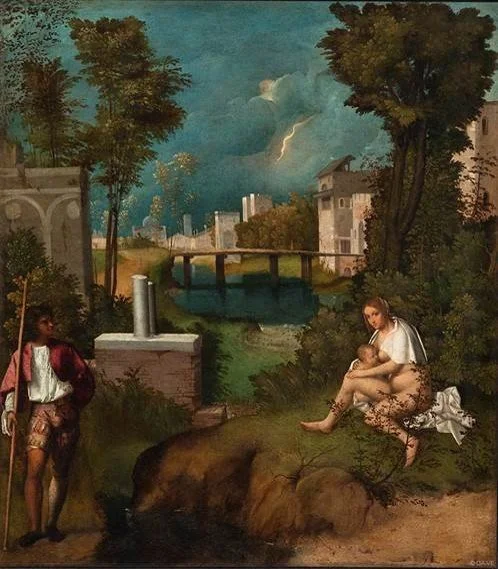
Giorgione, La Tempesta (The Tempest) 1505-08, oil on canvas, 83 x 73cm Galleria Accademia, Venice
If I teach this painting I usually ask my students to come up with a story to explain the presence of a naked mother suckling her child and a nattily dressed soldier holding a pike in this brooding, humid landscape. Other details need to be fitted into the stories they invent: the single fork of lightning in the pregnant clouds, the gilded light on the poplar leaves, the stork on top of the slanted roof to the right, the broken columns and arcade, the stream separating the foreground couple. One possibility is that he could be the father; she, the mother, and their child could be present only in his memory … there are many others and, somewhat frustratingly, there is no right answer.
We do know that Giorgione was one of the first great innovators of oil paint, a new medium which had been introduced to Venice from northern Europe. We also know that he died from the plague in his early thirties and that collectors paid huge sums for the handful of paintings he left behind. Even now, only six are authoritatively attributed to him. Byron, by the way, considered this his favourite picture while maintaining, disingenuously, that he detested painting. For me the central clouds are depicted in the most beautiful blue/green of any painting I know. In 1943 an Italian administrator hid the work under his bed to prevent it being looted by German soldiers.
Reams have been written to identify, let alone interpret, the subject matter of this painting. It turns out that its title dates back only to the late nineteenth century. As to the story, no one actually knows. It may well be that Giorgione didn’t know either. His purpose could have been simply to evoke or suggest rather than retell or describe in any precise, prescribed manner. I’m reminded of something Picasso said of his more indecipherable Cubist works: ‘It’s not a reality you can take in your hand. It’s more like a perfume – in front of you, behind you, to the sides. The scent is everywhere, but you don’t quite know where it comes from.’ The scent or the mood here is certainly melancholy. While the surroundings are lush and fecund, the atmosphere is threatening; human bonds seem fragile and, like the architectural ruins, easily broken. That stork will surely fly away before the storm breaks.