September 2026
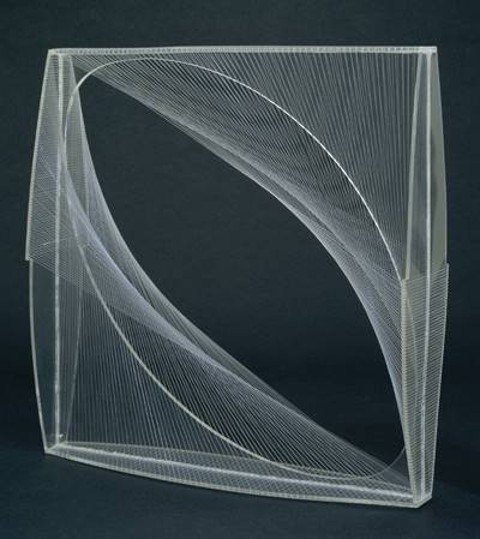
Naum Gabo, Linear Construction No.1, Variation 1942-43, plastic with nylon thread 35 x 35 x 9 cm Tate Britain
David Attenborough has made many, if not all, of us feel guilty about plastic. We almost certainly don’t react to it in the same way that people did a couple of generations ago. There was a time, in the 1960s, when nylon shirts, drip dry and with no need to iron, seemed the very peak of modern, easy living made possible by the miraculous properties of man-made synthetic materials. Some of my school shirts were made of the stuff in the early 1970s and were hot, itchy and gave you regular static electric shocks. Despite this and, much more grievously, the environmental plight that plastic waste has caused since then, I love Gabo’s works. They seem infused with a peculiarly modern optimism. By this I mean he used materials that were not usually associated with traditional sculpture to create intricate and beautiful abstract constructions: as though these stuffs, which had transformed industry, manufacturing and design also deserved aesthetic form. In this one he plays straight against curve. The inner plastic frame is square, its edges bulge outwards with sections of elliptical curves; within the square a complete ellipse tilts on its side almost touching two corners. Fine nylon filaments are threaded over this structure: each one is taut and straight but together combine to create a second ellipse. The whole is light, transparent, geometric, symmetrical but also dynamic. One other thing: though it might celebrate a machine age, it was made by hand - there was clearly a lot of delicately skilled craft involved.
Gabo lived through much of the turmoil and turbulence of the twentieth century: born in Russia, he lived through the First World War and Revolution, active as an artist in the early years of Communism before Stalin’s purges forced him to emigrate to France, then Britain and finally America. This piece was made in England during the Second World War. In other words, he had good reason to distrust the role machines had played in the violence of European history but chose to turn the sword into a ploughshare. And while this is clearly single-use plastic it won’t, thankfully, end up in the sea.