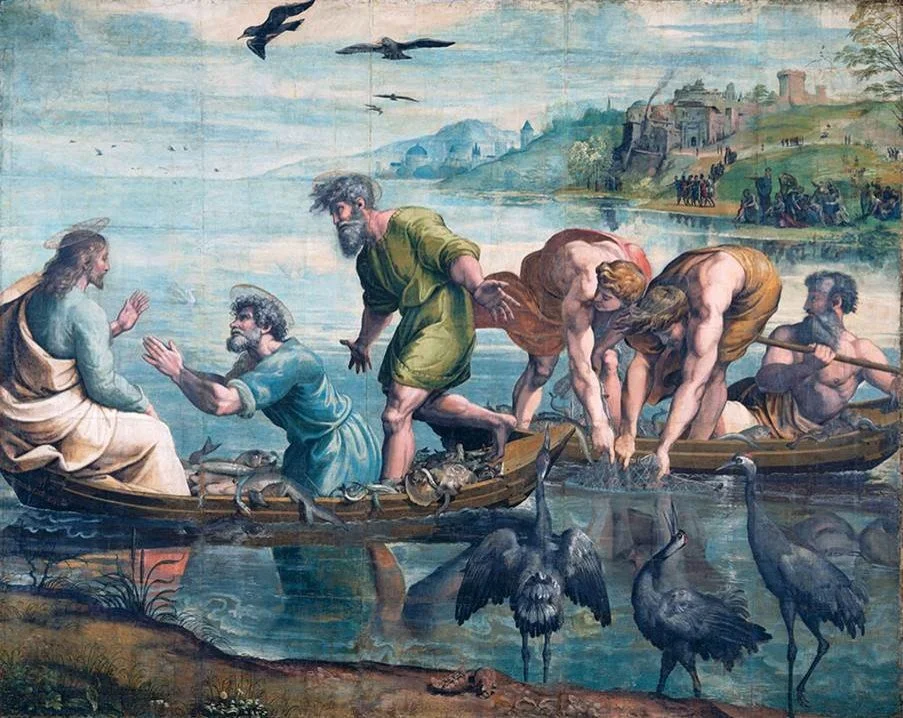
Raphael, The Miraculous Draught of Fishes, 1515-16, bodycolour and charcoal, Victoria and Albert Museum
This is one of Raphael’s cartoons, massive gouache works on paper, which were used as designs for a series of tapestries made to adorn the Sistine Chapel. They’ve been on view in the V&A for years, though the enormous room where they are hung is never crowded. They remain the single most important examples of High Renaissance Italian art in the UK.
This piece portrays the Miraculous Draught of Fishes as described in the Gospels. Peter and some of the other disciples have returned from a fishing trip empty handed. Christ exhorts them to go back out and ‘cast your nets on the other side’, which they do to stupendous effect: you can see the left hand boat, lower in the water than its pair, teeming with fish. At this moment it is Peter who is the first to realise that this extraordinary figure, the mesmeric carpenter’s son, is no ordinary man. He drops to his knees and exclaims, ‘Depart from me, O Lord, for I am a sinful man.’ The implication of his remark is that Jesus is without sin, that he is the Messiah, the Christ.
As you look down the rest of the composition you realise that the others have little or no idea what has suddenly struck Peter. Andrew, in green, steps towards them to ask what’s going on; James and John are still hauling in their nets; Zebedee is calmly steering their boat thinking of something else. The whole composition, in other words, reads from right to left as a progression of understanding: from ignorance to dim awareness that something special is happening, to full revelation.
For the Pope, Leo X, who commissioned Raphael, this was effective propaganda, promoting Papal wisdom and prescience at a time of deep theological division. The point here is that while Raphael was limpidly composing his design, Luther was agitating in Germany. It was a canny commission from Leo X, in other ways, because he knew Raphael would pull out the stops in these designs: because Raphael would have been well aware his work would be compared to the ceiling Michelangelo had recently completed in the same chapel. For us, in addition, it’s an image that expresses with supreme clarity the miraculous wonder of those moments of discovery when the penny or our jaws drop and we too, metaphorically, fall to our knees.