August 2026
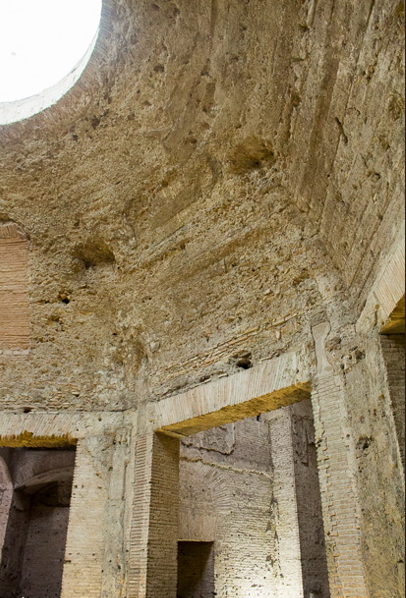
Triclinium of the Domus Aurea, Rome, 1st century AD
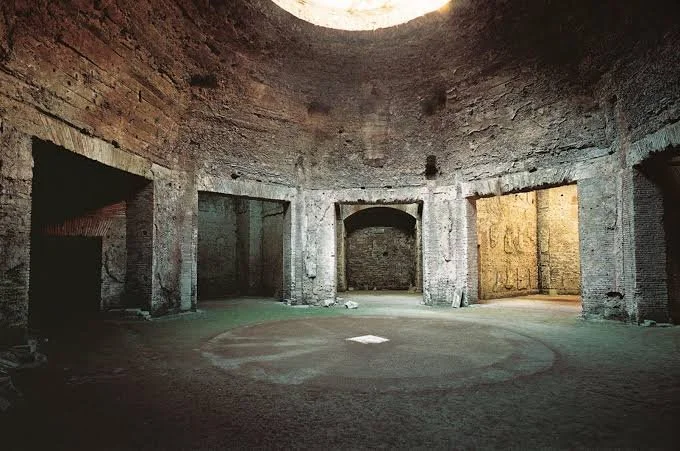
Nero does not enjoy a great reputation: he ordered the murder of his wife and mother as well as the mass persecution of the Christians in Rome during which, momentously, St Peter was executed. In Rome itself, following a devastating fire in 64 AD, which he may well have orchestrated, Nero sequestered an area in the centre of the city approximately the size of Hyde Park to build his palace, the Domus Aurea or Golden House. The historian Suetonius records that its entrance colonnade was a mile long with a vestibule large enough to house a statue of the emperor one hundred metres tall. The interior was overlaid with gold leaf, mother of pearl and ivory. The dining room (pictured above) was octagonal in plan and top lit from an open oculus within a spherical dome, with diffused light entering from the sides. Suetonius notes that the room itself revolved, with panels that slid open to sprinkle guests with petals or perfume. It is no wonder his successors tried hard to distance themselves from him.
But we should acknowledge Nero for promoting and developing one of the great innovations of Roman architecture: concrete. It had been in use in the previous century but not on the epic scale we find at the Domus Aurea. Domed spaces like this one would provide the template for later masterpieces like the Pantheon. When Nero’s successor, Vespasian, gave the Colosseum to the Roman people, it was built on the site of the palace gardens and constructed, in only ten years, out of concrete.
Later emperors, Titus and Trajan, built large bath complexes over the palace in order to eradicate its memory. Over a thousand years later everything had been buried underground. In the late 15th century artists discovered some of the vaults, still stuccoed with elaborate grotesque decoration, whose patterns they immediately incorporated into their own paintings. A few years after that the statue of Laocoön was dug up in a vineyard nearby. Building in concrete was revived too but only in the second half of the 19th century.
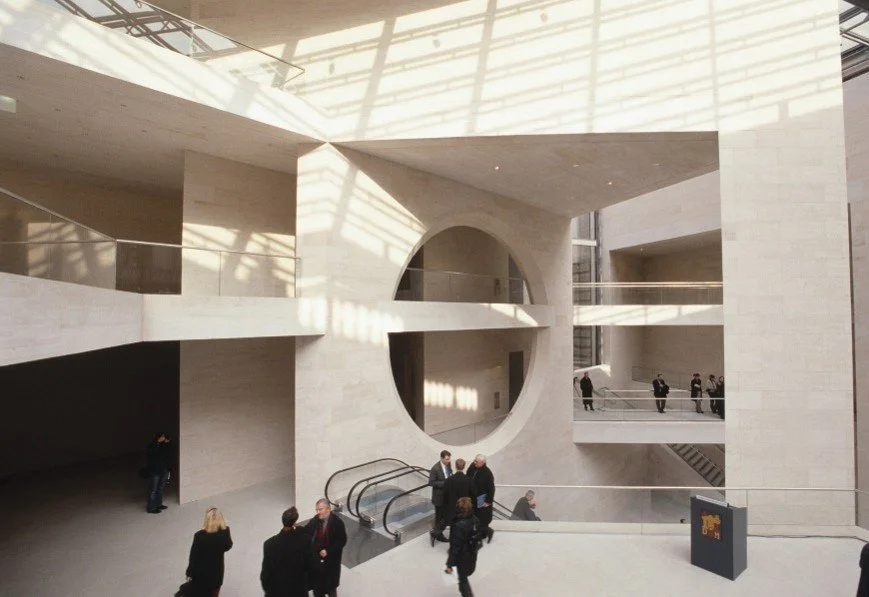
I.M.Pei, atrium of the Deutsches Historisches Museum, Berlin, 1998-2003
The whole complex of palace and baths was systematically excavated in the 20th century; all of the precious materials in the Domus Aurea had been stripped long before. I think I prefer it this way. This room, its concrete structure exposed, reminds me of a nodal point on one of those new(ish) stations on the Jubilee Line or a detail from a museum building by I.M. Pei, architect of the new Louvre entrance, the National Gallery in Washington, and the museum in Berlin pictured above, each one a masterpiece of modern, democratic, civic concrete construction.