July 2026
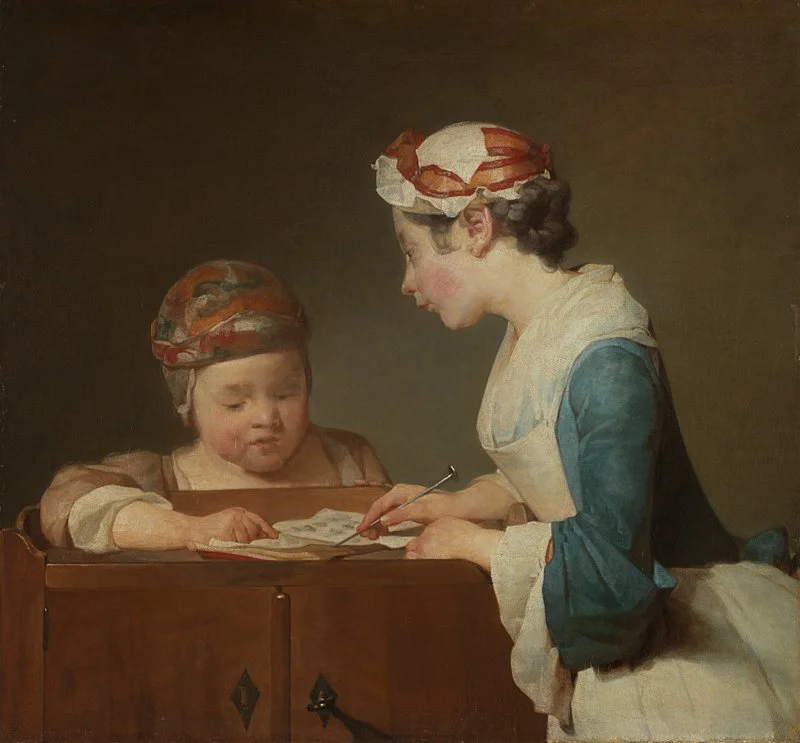
Jean Siméon Chardin, The Young Schoolmistress, c1736, 61.5 x 66.5 cm, National Gallery
This painting could be said to verge on caricature or sentimentality but something about it saves it from both: restraint and clarity on the one hand, sheer painterly quality on the other.
We can all recall moments, when, like the frowning young child here, the equation or spelling or verb tense simply wouldn’t go in, no matter how hard we tried: when the key (look at the cupboard’s lock) to the door of knowledge wouldn’t turn. There’s something slightly threatening about the sharp metal pointer held by the schoolmistress or elder sibling, but though her lips are pursed she leans forward in stern sympathy towards her pupil. In other words, there’s a bond between them as well: the child’s pointing fingers signals she’s making a big effort to understand and both figures share red scrubbed cheeks and clean hands.
The beauty of the work lies in its detail and brushwork. The same blues on the schoolmistress’s sleeve appear on the child’s right shoulder, in the shadows either side of her nostrils and the knuckles of both; we can glimpse a tiny section of arm where the teacher’s cuff has detached from the blue sleeve of her dress; above all, for me, there’s the freedom of colour and shape with which Chardin has constructed the child’s hat, less defined because it’s emerging from half shadow. It prefigures Cézanne’s painstaking construction of form out of colour alone. Her face, slightly blurred, is groping towards the clear light which defines the profiled features and clothing of the teacher. The twentieth century painter Lucian Freud, who copied this painting in oil and etchings, described the schoolmistress’s ear as the most beautiful ever painted.
Chardin’s works, like this one, of everyday scenes of bourgeois life, appealed to an aristocratic audience in mid-18th century France, not too long before they would lose everything in the Revolution and the Enlightenment world which Chardin modestly celebrated was irrevocably overturned. No amount of verb learning was going to stop that.