June 2026
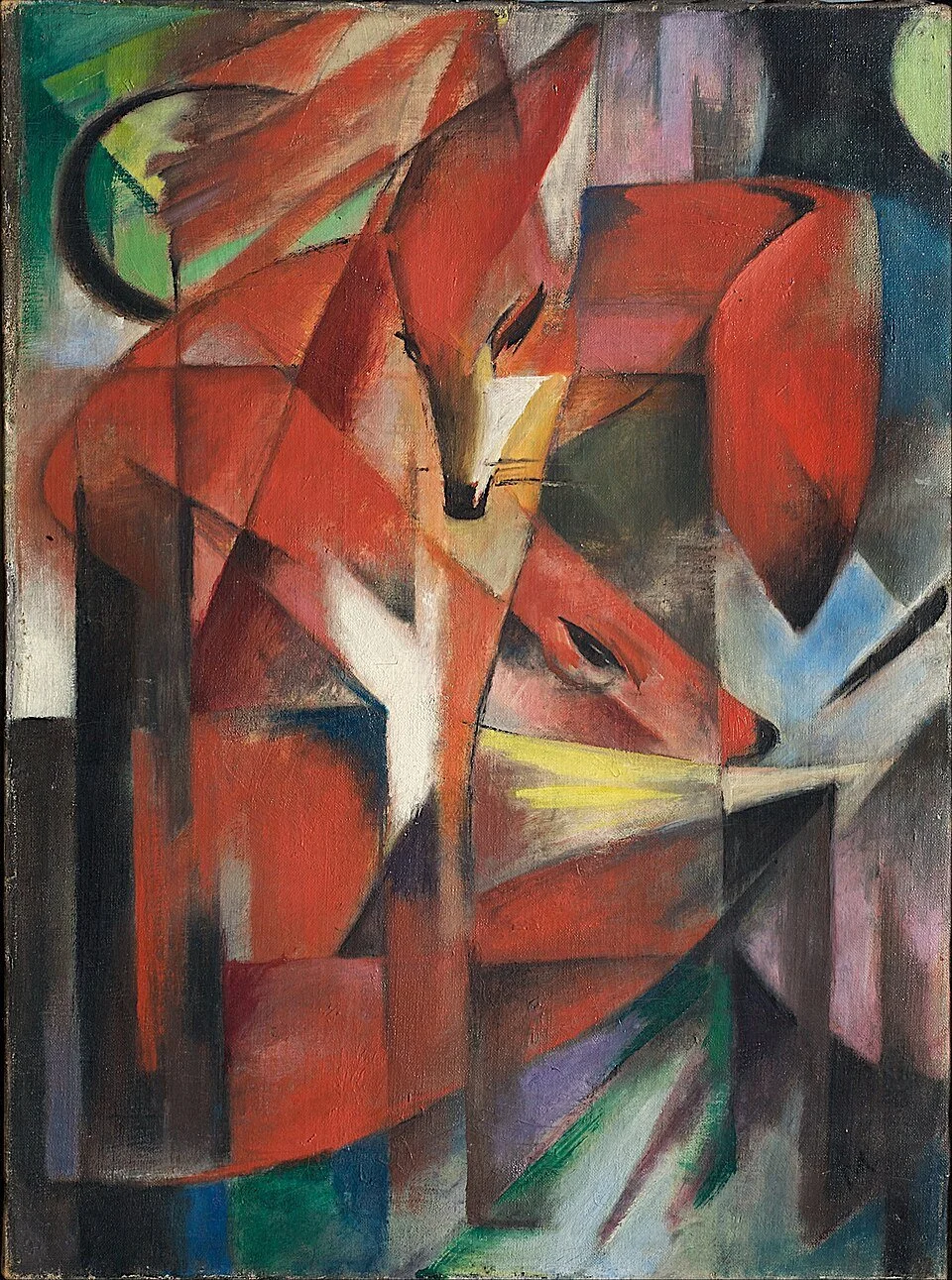
Franz Marc, Foxes, 1913, Museum Kunstpalast, Düsseldorf
Marc was an early twentieth century German artist, based in Munich, who worked closely together with Kandinsky as the leading figures in a group called Der Blaue Reiter (The Blue Rider). The name was metaphorical. ‘Blue’ signalled spirituality (the colour of the heavens). ‘Rider’ suggested the idea of a journey in which the artist, akin to a priest, could lead the viewer to a deeper, even transcendent understanding of experience. To do so there was no need to paint in a conventionally realistic style which was in any case tied to the material world. For Kandinsky, this was the spur which led him into abstract or non-figurative painting, one of the first Europeans to do so. But for Marc it was the animal kingdom which best expressed his own dreams and aspirations, and which he presented as an antidote to modern, urban and industrialised life.
Here, two foxes crouch in the undergrowth, one above the other; they are not predators but protector and protected. Both they and their surroundings have been fragmented into geometric shapes which overlap and bleed into each other. Centrally placed curves contrast with straight and diagonal edges but the overall effect is one of integration between creature and environment. This highly artificial style, the height of the modern at the time, has been borrowed and adapted from Picasso and Braque’s Cubism but turned to very different account. Marc converts their philosophically suggestive but monochrome studio still lifes into a colourful celebration of pantheistic idealism. There is an awful irony in what followed. Marc joined the German army in 1914 and specialised in painting camouflage tarpaulins to protect artillery from the enemy. By 1916 his name was included on a list of artists who were to be withdrawn from the front line; before the order reached him he was killed by shrapnel at the Battle of Verdun.