May 2026
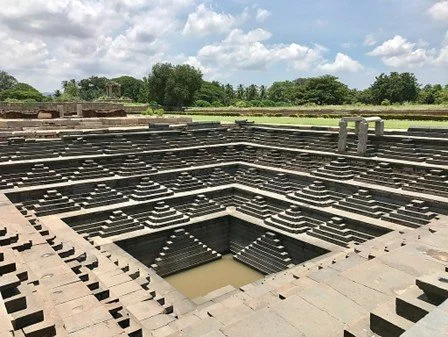
Stepped tank or public bath, Hampi, 15th century, India
As summer approaches and we start to dream of swimming on the beach here is a 500 year old bathing pool from southern India to feed our imagination and whet our appetite.
Hampi was the centre of the Vijayanagara Empire which lasted from the 14th to the 16th centuries. In its heyday Hampi had a population of 250,000 (considerably more than London at the same time) and was then India’s richest city. It was destroyed in the mid 16th century and lay in ruins until its rediscovery in the 19th.
Baths like this were linked to temples and are known as pushkarani. They were fed by aqueducts (one of whose remains are visible towards the top right hand side of the photo above) and I imagine the water levels would have risen and fallen intermittently. It’s not clear if the pool was only for ritual use such as symbolic purification before entering the temple or for more mundane hygiene or both. To be able to bathe or wash oneself or indeed one’s socks surrounded by this sort of lithic, geometric perfection seems pretty wonderful to me, an architectural expression of how central a role bathing or washing plays in any civilised, urban culture. David Kossoff’s paintings of a crowded swimming pool in Willesden from the 1970s might reek of demotic sweat and municipal chlorine but in their own way they celebrate the same essential, communal need.
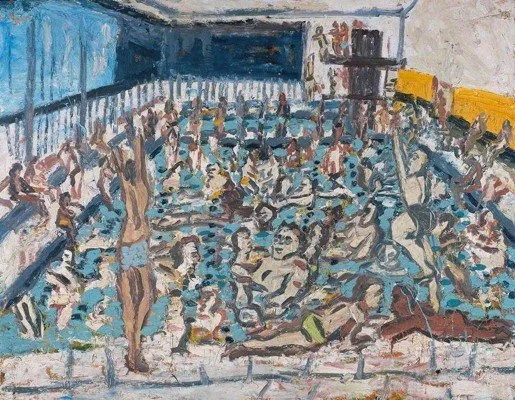
David Kossoff, Children’s Swimming Pool, Autumn 1972
Incidentally, the oldest swimming pool I could find on Google dates back to the 3rd millennium BC (its remains are in northern Pakistan). Tens of thousands of years before that our most distant ancestors congregated near rivers or the beach because they needed food; it was easy to find there as well as being safe: a river bank or beach gives you long sightlines and hence some protection from predators. But the point is that when we dive into the Atlantic or Mediterranean or the Serpentine this summer we’re doing something that connects us to our deepest human roots.