May 2024

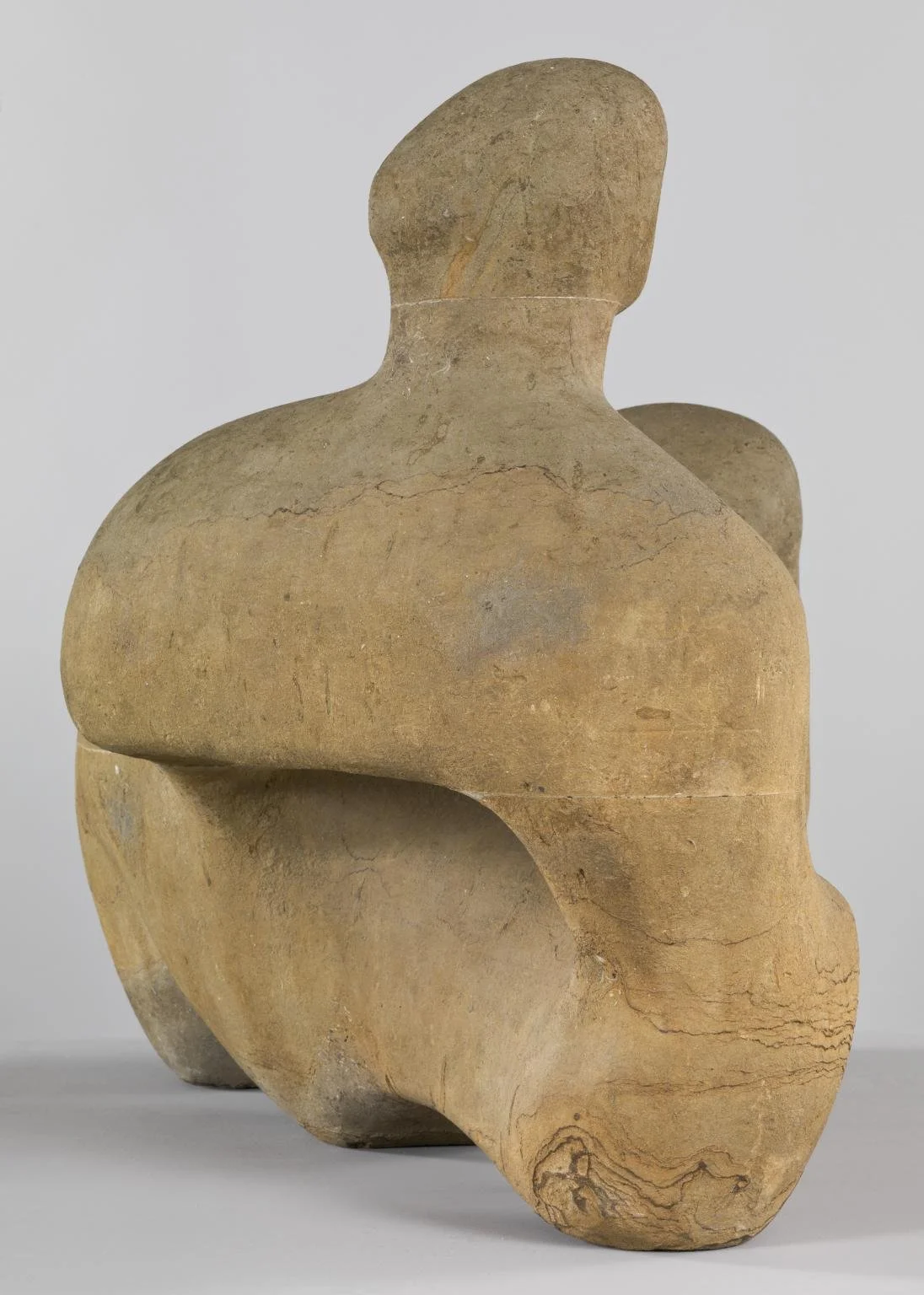
Henry Moore, Recumbent Figure, 1938, Hornton stone, 89×133×74 cm, Tate Britain

Moore’s figure is presented in organic terms: it’s clearly unnaturalistic but at the same time very natural.  Curved and cantilevered forms swell, dip, stretch and fold in on themselves in ways that evoke not only flesh and bone but also the undulations of landscape; so do the striations in the stone itself where tiny fossil remains are left exposed.  Hornton stone is an unusual choice of material for a sculpture: as you can see it is friable and flaky.  For this piece three separate blocks were glued together – the seams are clearly visible.  But it is a very English stone, warm in colour and appealing in texture, which is why Moore chose it. It is not the first work in which Moore used holes but they are fully exploited here: they unite front to back, making it emphatically three dimensional, inviting even insisting that you walk around it, something a single photograph fails to achieve, as does displaying it too close to a wall.

 This sculpture has had quite an eventful life.  It was commissioned for the garden of a modernist house in Sussex designed by the architect Serge Chermayeff.  Moore intended the piece to act as a soft, curved transition between the rolling hills of the South Downs and the rectilinear, vertically aligned forms of the house.  When Chermayeff went bankrupt it was bought by the Tate.  In 1939 the sculpture found itself stranded in New York, having been loaned for an exhibition there when war broke out.  On display outside it was damaged first by the freezing temperatures and second by vandalism; fortunately it has survived, albeit a bit battered.  Then, in 1972 it was chosen as one of 12 sculptures for a ground-breaking exhibition at the Tate for the blind where visitors were encouraged to touch the works in gloved hands.  I imagine that must have been very consoling.  So, although it was made outside, in the garden of Moore’s cottage in Kent, to stand outside in a Sussex garden, it now finds itself stuck inside in Pimlico.

Previous
Previous

June 2024

Next
Next

April 2024