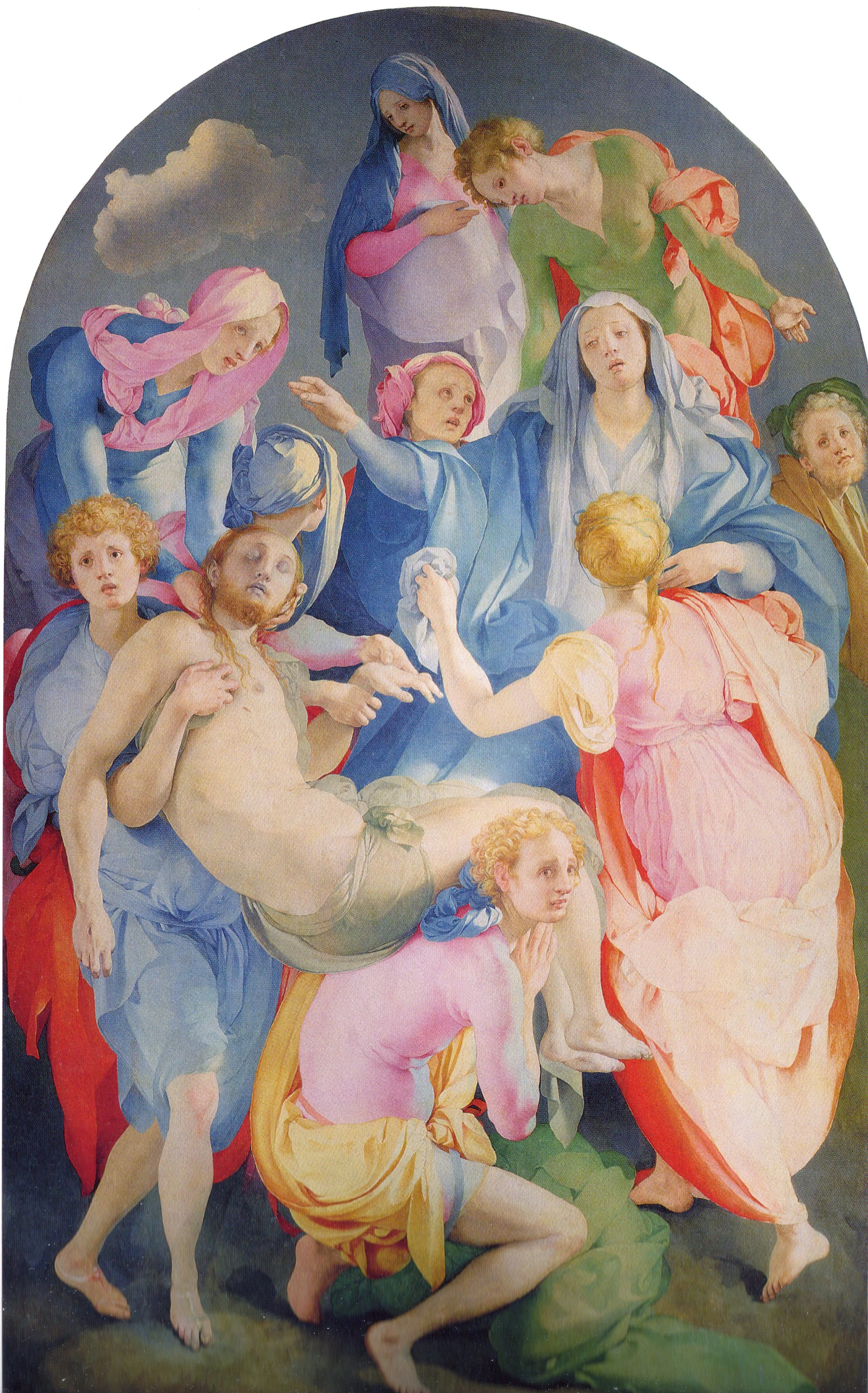
This is a very, very odd painting. The church where it hangs, San Felicità in Florence, just south of the Ponte Vecchio, is undervisited and has eccentric opening hours so be careful but definitely try to get there if ever you can. The painting’s just on your right as you enter. Resist the temptation to put coins in the light box, at least to begin with.
Cleaned and restored relatively recently, Pontormo’s Deposition looks unnaturally high keyed. The moment of the Passion shown, Christ’s removal from the Cross and Mary’s desperate swoon, is one of overpowering sadness; yet the dominant blues crackle, far brighter than one would expect. Mary’s robes, for example, would traditionally be a deeper, richer, darker hue. The pink, yellow and green in the figure of John, who supports Christ’s lifeless body on his shoulder, seem shockingly artificial. Then there’s the absence of familiar landmarks. Most extraordinary, we see no Cross, but also no hill, no Roman soldiers, no thieves. Christ’s body seems out of proportion, his legs and forearms too small, his torso too big. And John, we realise, is bearing its weight balanced preposterously on his toes. In the cluster of hands surrounding Christ’s head and left arm it’s not altogether clear whose hand belongs to whom. Then, as you survey the facial features of any the figures, we find they are all variations of the same face, one that beguilingly suits both male and female protagonists. This I can’t explain, though it reminds me of Christina Rossetti’s withering sonnet (In an Artist’s Studio) on her brother’s repetitive, obsessive, and possessive appropriation of a particular model’s face in his paintings.
But I think I can explain the palette – the family chapel where this altarpiece still hangs is dark and Pontormo’s strangely unsettling colour choices were needed, partly, to stand out from the shadows. The other oddities, anatomical and compositional, I’d explain as follows: the whole design acts as a visual metaphor, a cascade of grief, more elegiac than tragic perhaps, but nonetheless an orchestrated, serpentine descent of the limp corpse towards the unseen tomb. Seen in situ, however, we might also remember that during Mass when the priest lifts the Host in front of the altar, this image of slow sinking death is literally counteracted by the raising upwards of the transubstantial reality of resurrection and new life.