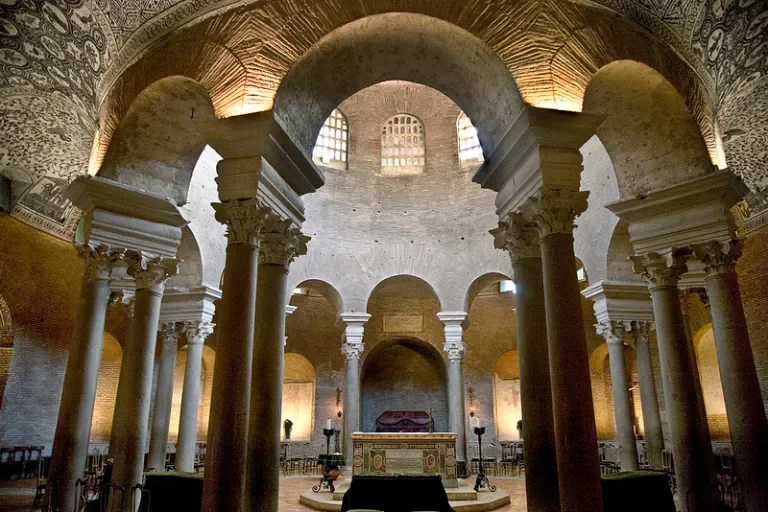
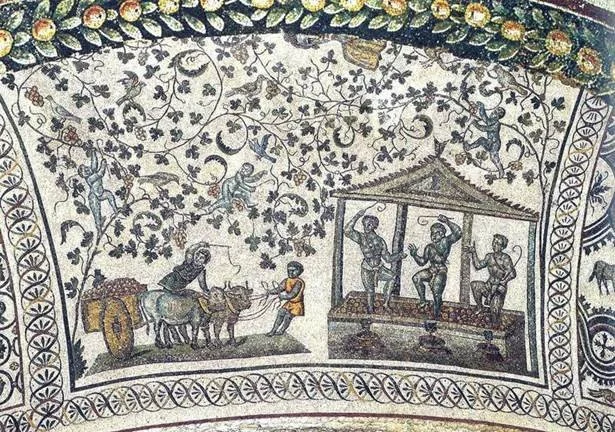
Take the no. 90 bus from Termini, the main train station in Rome, and stay on it for about half an hour. Look out of the window: you’ll go past Basil Spence’s controversial British Embassy from the early 1970. You get off the bus once you’re truly in the Roman ssuburbs at the church of Sant’Agnese, which is very wonderful in itself and where you can get taken down underground by a guide into a warren of catacombs. The church sits within a complex of grounds and other buildings, including a monastery, a bowling alley, a tiny café with rickety formica tables, a food bank and some allotments: in other words, more or less everything body and soul require. Beyond these lies Santa Constanza, now a church but once a mausoleum to the daughter and wife of the emperor Constantine and part of a much bigger basilica that has since disappeared. It is one of the earliest Christian buildings we know. On the ceiling above the circular colonnade or ambulatory are ancient mosaics that date from just after Constantine first legitimized the Christian faith. The mosaicists had no established tradition of imagery or iconography to draw on so that scenes like the one illustrated here (below) still look distinctly pagan. The crushing of the grapes we see in this scene prompted some visitors in the 15th century to think they were in a temple dedicated to Bacchus rather than a symbolic reference to wine and hence the blood of Christ. It’s an ancient place, still classical, and built before Rome fell to the barbarians, before the Latin language gave way to Italian, before the toga fell out of fashion, before gladiatorial combat was banned, before everyone forgot how to do long division with Roman numerals; but it’s also a place of new beginnings which in a roundabout way is rather appropriate as we stand at the start of MMXXVI.