February 2026
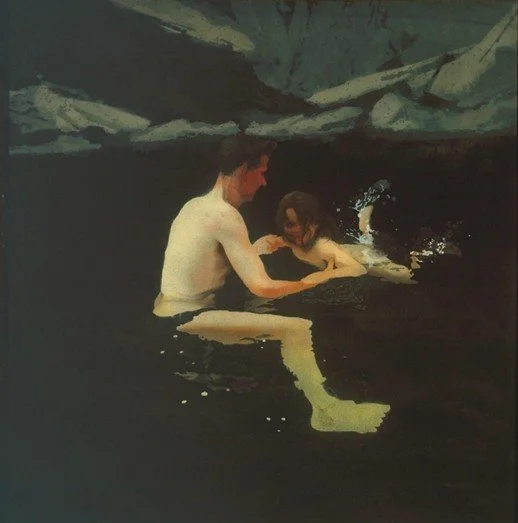
Michael Andrews, Melanie and me swimming, 1978-79, 183 x 183 cm, acrylic on linen, Tate Britain
I doubt Michael Andrews intended it but this painting is almost an inverse of the image we’re so used to in religious paintings of Mary and the Christ Child. But it is a monumental rite of passage. Do you remember the moment you learned to swim or perhaps your child doing the same? The father here, the artist himself, is about to let go and we can sense his concern just as we glimpse his daughter Melanie’s excitement. For learning to swim is to learn to be independent, to be free. Such moments are also fraught. The black water looks cold and threatening. The way Andrews has painted the figures, the enlarged foot, his sun-reddened neck and forearms all emphasise the frailty of flesh.
Michael Andrews is less well known than his friends and contemporaries, and the paintings of his owned by the Tate are, alas, hung less often now. His working method was slow and meticulous. Massive paintings like this took 12 to 18 months to complete. This one’s gestation began with a holiday snap, taken by a friend who was married to one of Lucien Freud’s daughters. It did not include the rocks which Andrews painted from memory but whose diagonals serve to focus attention on the figures.
Andrews’ paintings are the epitome of self-effacement; they betray almost no evidence of the artist’s hand. He used a spray gun on unprimed canvas to allow his colours to soak into the support; the rocks were painted by pressing cloths saturated with pigment directly onto the linen. As a result the work exudes a great sense of detachment; there is no signature or personality in the brushwork, the antithesis of Freud or Auerbach or Bacon.
Melanie, an only child, was 6 at the time; they were on a family holiday in Scotland near the spot where Andrews’ ashes now rest. She later recalled, ‘…the water was so dark you couldn’t see anything in it. It was so cold it had the effect of making you feel hot at first. I was learning to swim and it was at that moment that I really took off.’ I’m reminded of the last lines, with their veiled reference to Isaiah’s burning coal, in Elizabeth Bishop’s poem ‘At the Fishhouses’ and their invocation of another kind of freedom:
Cold dark deep and absolutely clear,
the clear gray icy water
[…]
If you should dip your hand in,
your wrist would ache immediately,
your bones would begin to ache and your hand would burn
as if the water were a transmutation of fire
that feeds on stones and burns with a dark gray flame.
If you tasted it, it would first taste bitter,
then briny, then surely burn your tongue.
It is like what we imagine knowledge to be: dark, salt, clear, moving, utterly free