Degas has frequently been accused of misogyny, partly as a result of things friends record him as having said, partly from the way some of his paintings or drawings have been interpreted, particularly his studies of women bathing. He almost certainly did subscribe to the patriarchal prejudices of his time though I’ve also thought that his contempt was more wide-ranging: more a misanthrope than just a misogynist. His politics were suspect, too: he was a supporter of the State against Dreyfus, in a court case that bitterly divided French society at the time, and which we’d now label anti-semitic. This is not to say that we can really know and therefore judge. And there is, I think, another side.
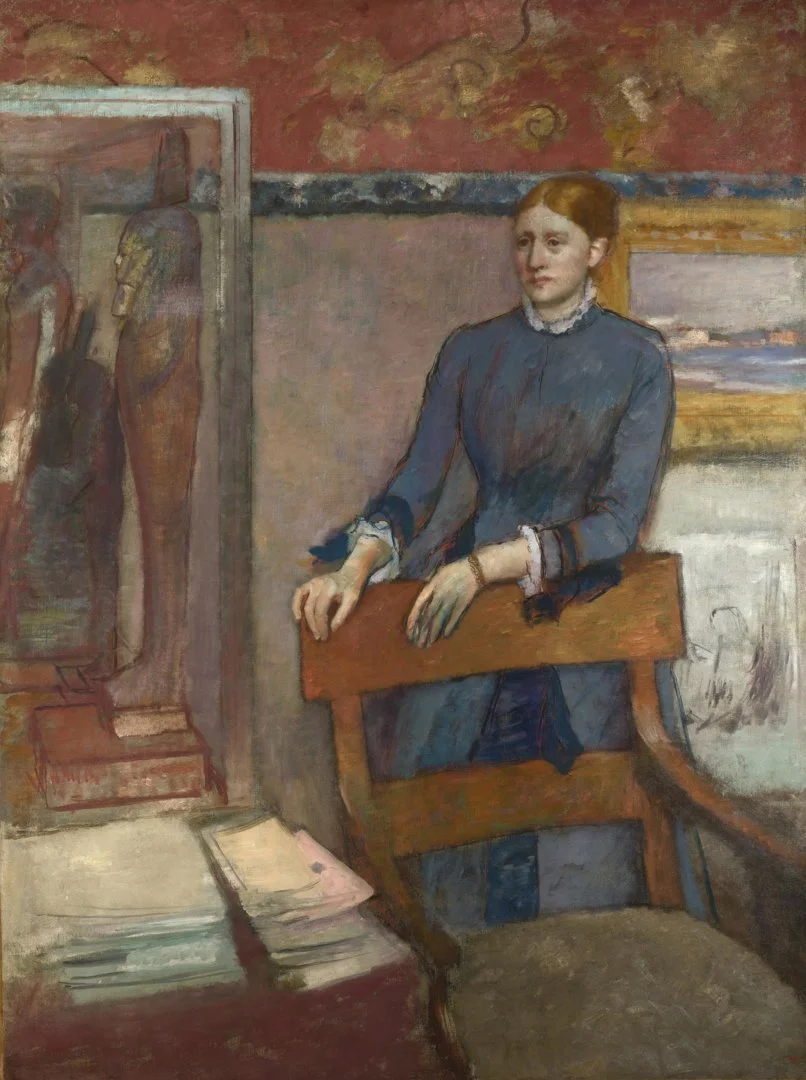
Hélène’s father was a childhood friend of Degas’. Rouart was a wealthy industrialist (his company pioneered early attempts at refrigeration), an art collector and sponsor of Impressionism. They had both enlisted in the militia defending Paris in the Franco-Prussian war. This portrait seems to have been the initiative of Degas, not Rouart – it stayed in Degas’ studio until he died. It also seems that Degas adjusted and reworked it over the years, particularly in the reds on the silk Chinese wall hanging.
It would be easy to see this portrait as one where the daughter is presented as one more of her father’s possessions. She is dwarfed by the metal framed vitrine, containing ancient Egyptian funerary sculptures, to the left, and outshone by the red Chinese silk behind her. Beneath it hang a landscape by Corot and a drawing by Millet. Trapped behind his enormous chair, with the papers we might imagine she has just tidied for him on his desk, she avoids our gaze. Hélène rests her hands listlessly; her thoughts are elsewhere. The left hand is ringless, though she was engaged at around the time the painting was begun. But the point is that there is no hint here of any form of filial independence.
I’m reminded of a phrase from the poem ‘Afternoons’ by Philip Larkin, a poet whose reputation has also been tainted with misogyny. In it he describes young mothers at a playground, ending with the withering couplet: ‘Something is pushing them/To the side of their own lives.’ To be aware of and to highlight the limitations a family or society place upon women is not necessarily to endorse them. There may even be empathy in Larkin’s poem though I’m not sure the same applies to Degas’ painting of Hélène. His works tend, rather, be more pitilessly clear-sighted than that but this is, even so, a beautifully constructed image of something we can fight against.