Leonardo da Vinci made birds eye drawings of the Tuscan landscape five centuries before the invention of the aeroplane. Maps are intellectual constructs that serve our need for communication and power and use the same idea of the aerial view. In the ancient myth of Icarus the human aspiration for flight becomes a metaphor for hubris. By contrast, in a metaphorical reversal, humanity’s loss of divine grace is described as the Fall. In other words, both the impulse to fly and its counterpart are powerful presences within our collective imagination.
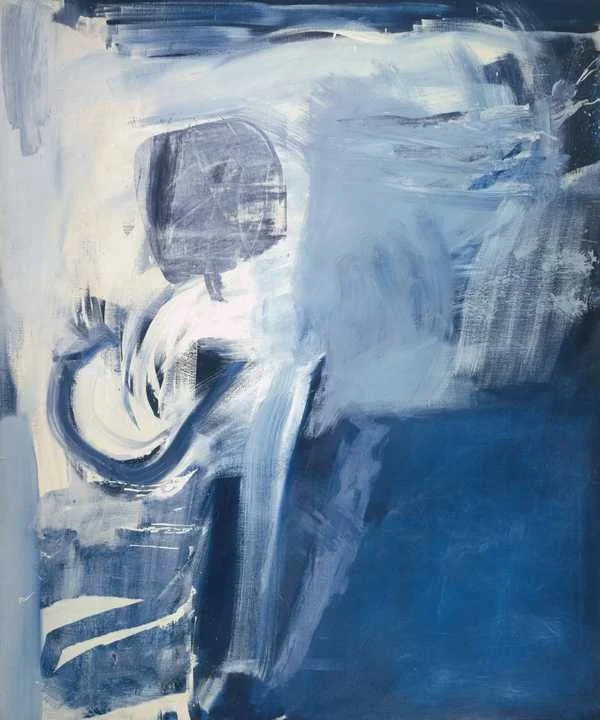
Peter Lanyon was born in St Ives, Cornwall, in 1918, just at the moment when the destructive power of aircraft had first been unleased in the First World War. Lanyon himself fought in the Second World War before becoming one of the St Ives’ school of artists along with Ben Nicholson and Barbara Hepworth. He took up gliding in 1959. Thermal is one of a number of large paintings he made in response to his experience of flight. In his own words,
'The air is a very definite world of activity as complex and demanding as the sea. The thermal itself is a current of hot air rising and eventually condensing into cloud. It is invisible and can only be apprehended by an instrument such as a glider. The basic source of all soaring flight is the thermal – hot air rising from the ground as a hot bubble.
The picture refers to cloud formation and to a spiral rising activity which is the way a glider rises in an up-current. There is also a reference to storm conditions and down-currents. These are all things that arise in connection with thermals.’
The way Lanyon translates all this into paint is visually very exciting. Works like this are not abstract, but neither are they literal descriptions. Instead, they seem to lie somewhere between the two. He combines superimposed layers of transparency and opacity, thick impasto with areas where paint is more liquid or in some parts scraped or scratched away to reveal a brief sharp edge. There is both energy and stillness, focus and blur, visual tension and release; all are used as equivalents for the sensation of flight amid the flux and flow of the clouds. The majority of Lanyon’s other paintings focus on Cornish landscape and ultimately it would be the land that called him back. Tragically his desire for the freedom of flight could not outstrip earth’s gravitational pull; Icarus-like, Peter Lanyon died in 1964 following a gliding accident.