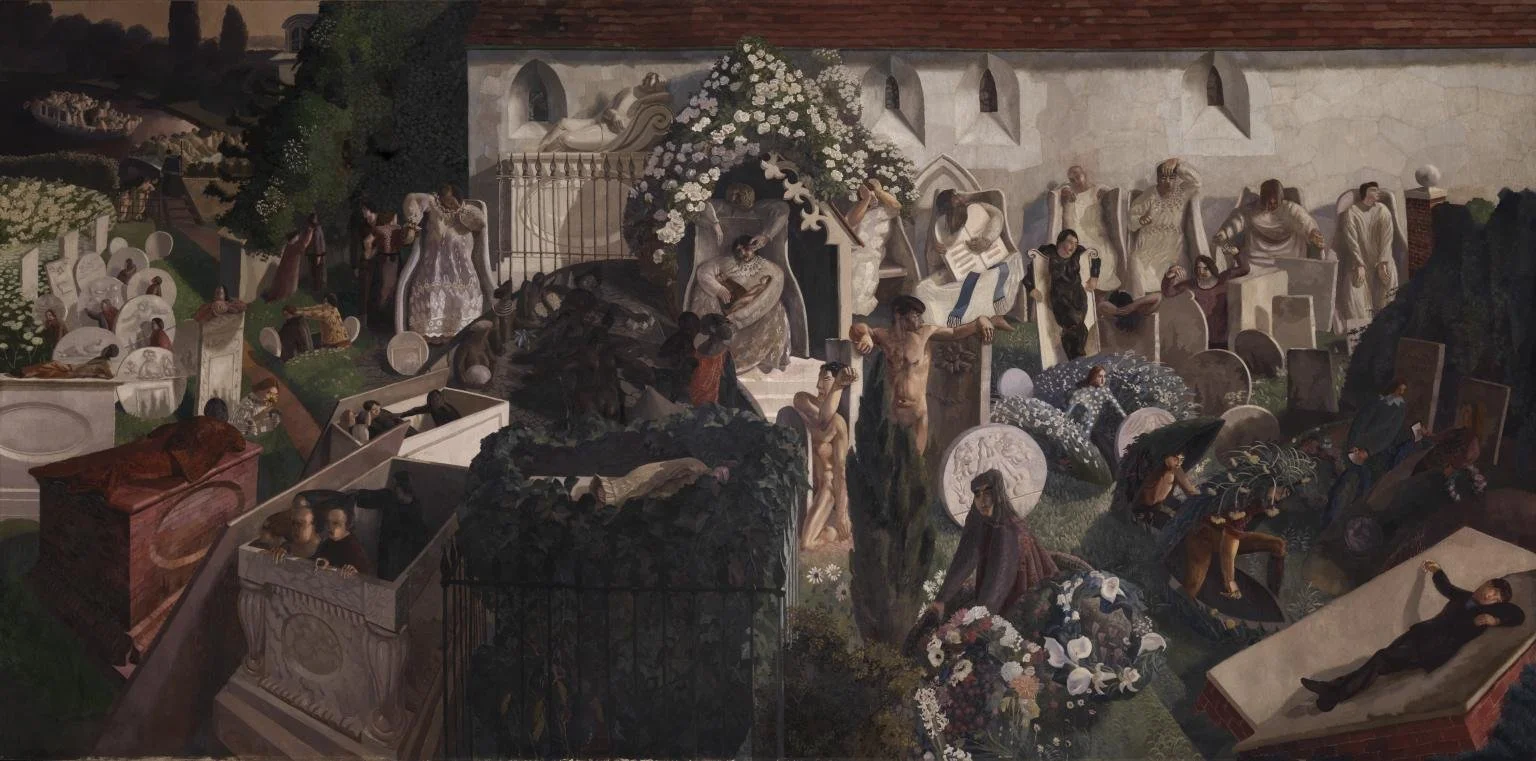
Spencer first exhibited this vast painting in London in 1927 whereupon it was promptly acquired by the Tate, in recognition that he had produced something extraordinary. It depicts a strangely naïve vision of the Resurrection, set in the crumpled space of the churchyard at Cookham, a village on the Thames where Spencer was born and brought up. Despite its monumental dimensions there is something immediately endearing about seeing this cataclysmic event take place in so modest and particular a location. In much the same vein, Spencer himself, quoting the seventeenth century poet and cleric John Donne, described Cookham as ‘a holy suburb of heaven.’
God the Father and Christ are seen in the porch with prophets stretching their limbs on stone seats to the right. To the left, just beneath the porch, a group of black figures lift themselves out of the earth. Their presence lends the image a wider geographical reference, since there were few Afro-Caribbean people living in the Thames Valley at the time. At the same time Spencer focuses mostly on the familiar. His wife, Hilda, for example, appears three times: crossing a stile, smelling a flower, and sleeping on the tomb in the centre. To the left, a woman brushes the dust off the back of a man’s jacket – apparently a memory of the artist’s mother. There are other light, imaginative touches of comedy: for example, some of the figures are reading the epitaphs on their own tombstones. Spencer wrote of them all: ‘No one is in any hurry in this painting… they resurrect to such a state of joy that they are content.’