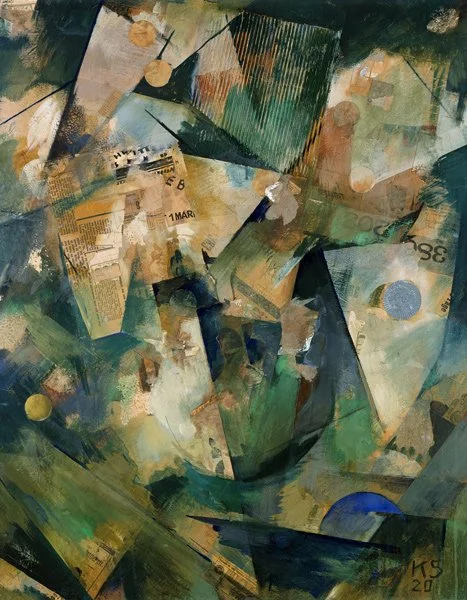
Outside our kitchen the cherry tree is today about to break out in perfect blossom but this is rubbish. More accurately it’s a collage of paper and cardboard made by Kurt Schwitters, a German artist who picked up the detritus from the streets of his native Hanover and delicately recast it into intricate, textured geometric form. Just off centre, an apparently random fragment of letters (‘1MAR’) gives the work its title while the layered swirls of green, blue and ochre suggest, if you want them to, organic life transforming the waste from which it springs.
In 1917, aged 30, Schwitters had been conscripted unwillingly into the German army. In the immediate post-war years, when Germany was in a state of social, political and economic collapse, he started making his characteristic collage constructions such as this one. As he himself noted, ‘everything had broken down and new things had to be made out of the fragments.’
Schwitters died in the Lake District in 1948 having fled to Britain from both Norway and before that his native Germany, on both occasions escaping arrest by the Gestapo. His paintings had been included in the notorious Degenerate Art exhibition organised by the Nazis in 1937. An extended architectural collage, in which Schwitters reconstructed his entire house into a three dimensional labyrinth known as the Merzbau, was destroyed in an allied bombing raid on Hanover in 1943. I hope something might be growing now in what was the garden there, but even if not, it’s still an honour that we gave him refuge.