June 2023

Le Corbusier, Notre Dame du Haut, Ronchamp, France, 1955
I was very pleased when I read Germaine Greer likening the exterior of this extraordinary chapel to a mushroom. Judging by the shapes of its walls and roof, she’s referring, I think, to the penny bun or cep or porcini, the royalty of the fungal kingdom. It may seem surprising that a building by Le Corbusier, an architect infamous for saying that a house is ‘a machine for living in’, should lend itself to an organic simile. But this is a late work and unlike his earlier designs, nothing is straight: walls bulge and curve, varying sized windows are placed in seemingly random clusters. The material is reinforced concrete, mostly painted white, while the massive sections of the roof have been left untouched with the imprint of the wooden shuttering (these are the planks used as moulds into which the concrete is poured) still visible.
There’s something hefty and solid about it all, but what’s really special is the way the whole seems to thrust upwards. The roof, in particular, soars skywards. One section, to the right in the photograph above, resembles the underside of a massive hull turning the building into an ark-like vessel of salvation. On the inside it becomes apparent that there’s a tiny gap between wall and roof, creating a delicate horizontal sliver of light. It’s noticeable on the exterior, too, though less obviously, but plays an important part in the building’s dynamic defiance of gravity.
Le Corbusier was commissioned to replace a 4th century chapel that had stood on this spot but was destroyed in the Second World War. The thickness of the walls, their rough textures, the mystical light that is diffused through the slanted window apertures, the shapes of the bell towers – all these details seem intended to recall much older traditions of church building from an architect who was demonised as a brutalist. In truth, this is a hymn, both ancient and modern.
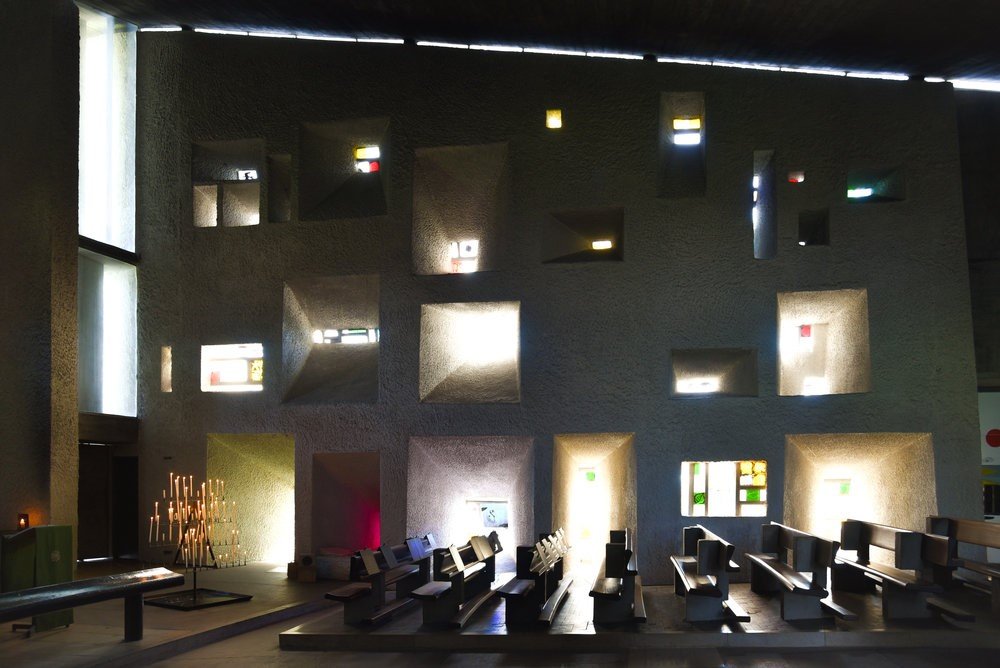
The interior