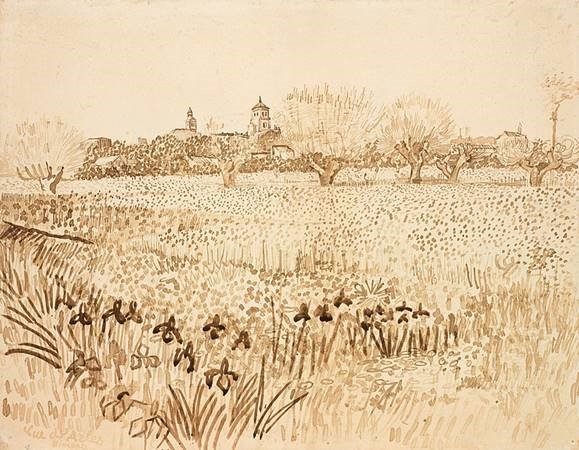
There is an extraordinary economy in the style of this drawing, made soon after Van Gogh had moved from Paris to the southern French town of Arles where he hoped to set up a colony of like-minded artists. His dream would be disappointed by illness, but here the energy of both the marks made by his Japanese reed pen and the vigour of the plants and trees themselves, speak of a moment of great optimism and hope. The scene has been reduced to a series of curt marks, a sort of visual shorthand. Similar touches, varied only by the amount of ink on the nib or pressure applied by the hand, are repeated over the sheet yet are used to describe very different things. For example he uses a dot like mark to describe the grass in the foreground fields; the same dot is used for the trees amongst the distant buildings, but here they are closely bunched to create an effect of density while for the grasses they are more widely separated. In this way he was able to exploit the white of the paper to create a sense of light and movement, as though a breeze were blowing over the field. These strong, beautifully controlled graphic rhythms expressed his own sense of nature’s benign vigour. Van Gogh used to sign off his letters with the phrase, ‘With a firm handshake, Vincent’: something of the same muscular energy can be felt in this drawing.