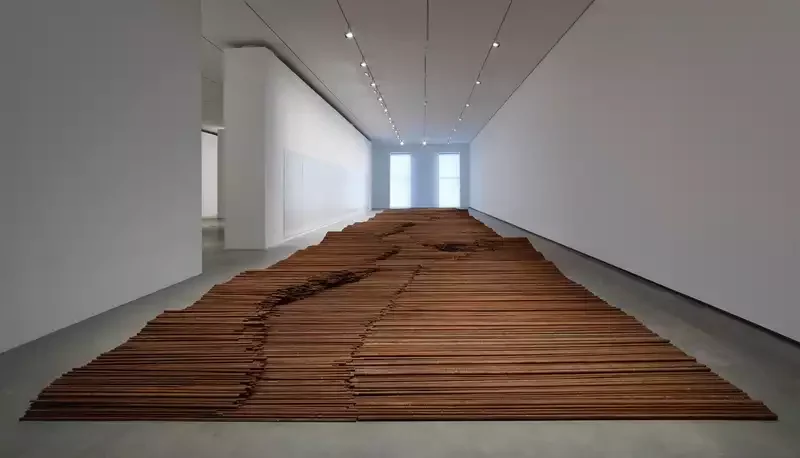
In 2008 an earthquake devastated the Sichuan region of south west China. The damage and loss of life was appalling. One crucial reason why so many lost their lives was that corrupt property developers and planners had allowed large numbers of buildings, including schools, to be constructed with substandard concrete which didn’t meet regulatory requirements and was always going to be prone to collapse.
What Ai Wei Wei then did was anonymously to collect tonnes and tonnes of the steel reinforcing rods, sometimes knows as rebars, from amongst the rubble. These were twisted and buckled but Ai Wei Wei employed a team from the local population to hammer them back into their original shape – dead straight. These have then been arranged as you see in the photographs above. The work has been shown at various exhibitions around the world including the Royal Academy in 2015.
The stacks of rods resemble gently rolling hills, riven with fault lines, seen from above; alternatively, seen side on they could resemble the characteristic curves of a seismic graph. In one sense the whole enterprise is or was a vain one. Can an artist or a work of art put right something that was so obviously wrong? Clearly not. But can an action like this signify the desire to do so? Yes. In this case the collective effort required to straighten all those hundreds of steel rods back to true, and then their arrangement into folding swells and rises, as if those of a benign landscape, offer some sort of riposte to our impotence. Its sobriety takes us beyond anger which, I suspect, was Ai Wei Wei’s starting point. He himself was arrested, beaten and imprisoned by the authorities for his pains.