It took me many years to enjoy Poussin. He was too cold, too cerebral, too calculated, clean and clinical; his paintings lacked passion, sensuality, warmth. His brushwork was too meticulous, his colours, paler versions of something more full blooded and so often limited to the primaries, lacked vitality. Though some may agree, I do believe I was wrong.
Born in Normandy Poussin lived and worked for almost all his life in Rome. As a young man he made two or three attempts to get there from Paris only to have to turn back through lack of funds. When he did get there, early promise was followed by failure and frustration (a commission for an altar piece in St Peter’s was cancelled), but then by a slower success, in which he found favour from a small group of loyal patrons and collectors. In this way working in private for an erudite audience, he was able to embark on the careful and considered development of small scale pictures like this.
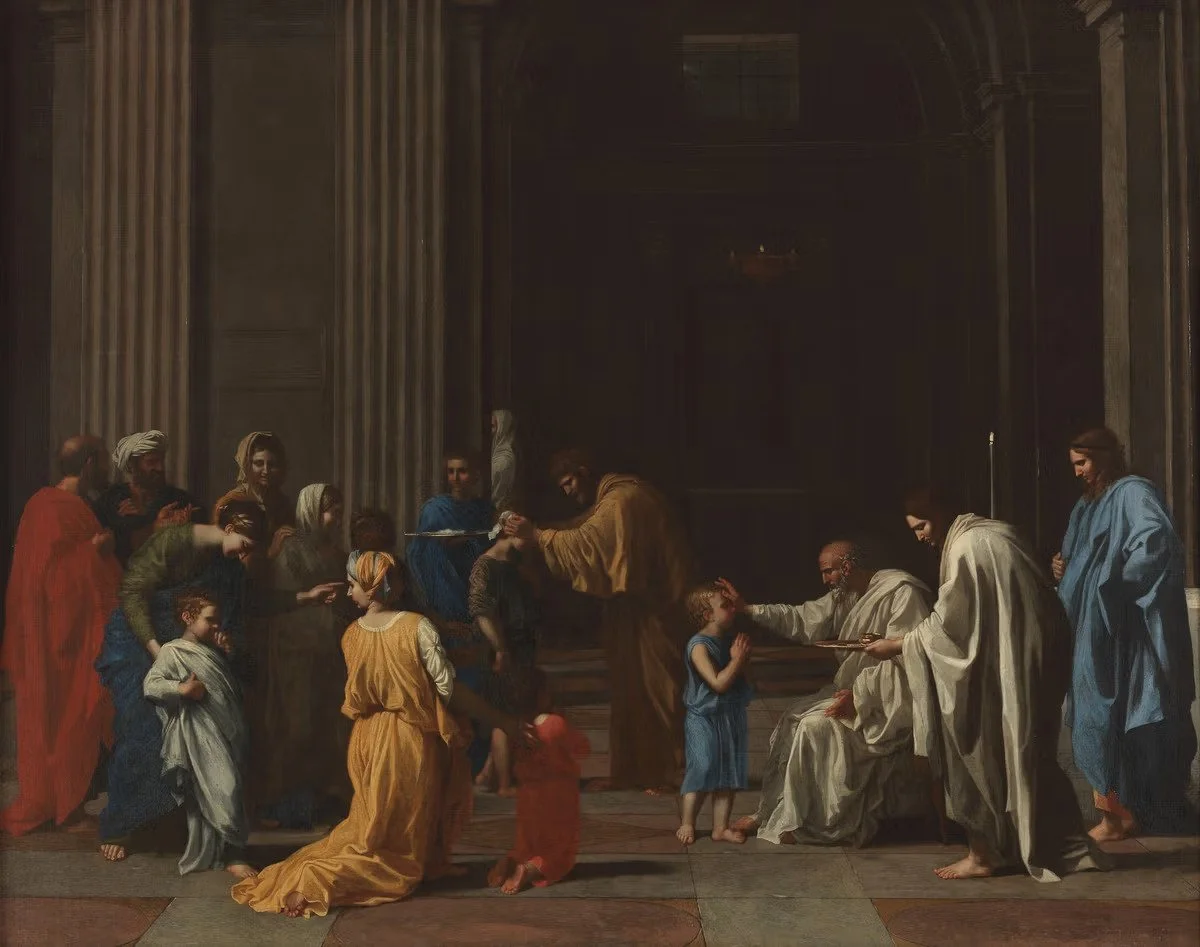
It’s one of a series of works he made of the seven sacraments for one of his learned patrons. A group of men, women and children, all in classical Roman dress, set the event in an imaginary early Christian Rome. It’s located in a classical architectural space based on the actual church in via Babuino where Poussin was living (not far from the Spanish Steps and only one street down from via Marguta where Gregory Peck had his apartment in ‘Roman Holiday’, and also pretty close to the apartment where Keats would die).
The main attraction here, precisely what repelled me earlier, is the artifice. The rhythm of it, its musicality – the sense of slow progression from left to right – is articulated in rhyming pose and repeated colour as our eye is drawn to the climactic moment of blessing. One child, in white, reverses this flow, attracting the attention of the kneeling woman in yellow whose gaze also acts as a counterpoint to the dominant axis leading towards the right. But his hesitation only reinforces the sense of how momentous this ceremony is. Then there’s the architecture itself – those vertical accents which counteract and dynamically balance the horizontal flow in the figures. Consider too the weight of empty space in the dark interior, taking up half the composition, with the judiciously placed pin pricks of candle light, adding to the solemnity.
This is not anecdotal art, it’s conceptual. These figures are not nameable individuals but neither are they allegorical personifications. Each has their part to play in a ritual that is bigger than they are – it’s the collective, communal nature of the sacrament that is being celebrated here.